Last updated: May 2026 | TopWeddingFavors.com
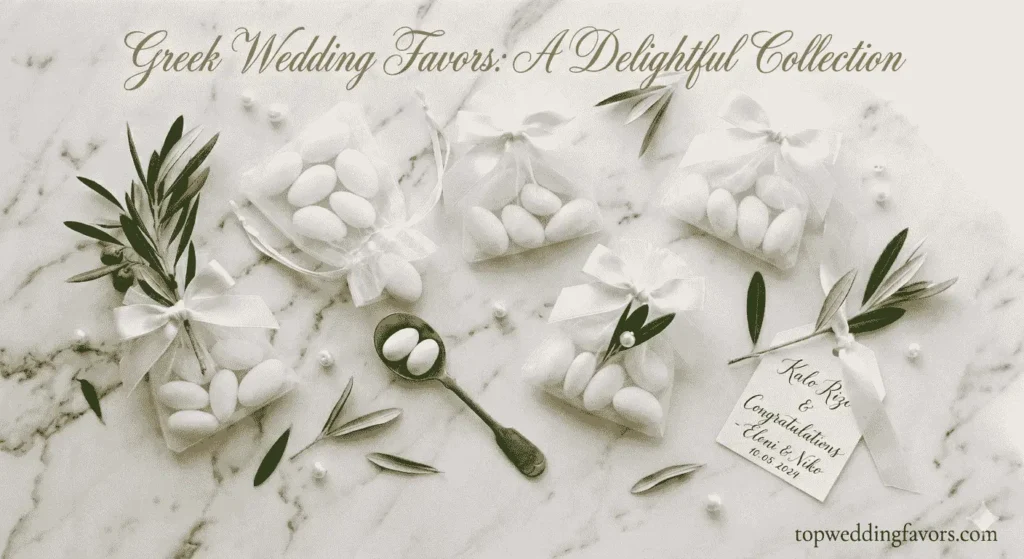
If you’ve ever attended a Greek wedding, you know that moment at the end of the night — when someone places a small, beautifully wrapped pouch in your hand, tied with a satin ribbon bow and filled with sugar-coated almonds.
That little favor carries centuries of tradition inside it.
Greek wedding favors are not an afterthought. They’re a deeply symbolic gesture — a thank-you, a blessing, and a piece of the celebration that guests take home with them. Whether you’re planning a full Greek Orthodox ceremony or simply love the elegance of Greek wedding traditions, this guide covers everything you need to know.
From traditional koufeta boubounieres and bombonieres to olive oil gifts, DIY ideas, and where to find Greek wedding favors in Astoria, NY — I’ve put it all together here.
What Are Greek Wedding Favors? Bombonieres, Boubounieres and Koufeta Explained
Before we dive into ideas, let me clear up the terminology — because it genuinely confuses people.
Walk into any Greek wedding favor shop and you’ll see the words boubounieres, bombonieres, and koufeta used almost interchangeably. They’re related, but they’re not exactly the same thing.
The Difference Between Koufeta, Boubounieres and Bombonieres
Koufeta are the Jordan almonds themselves — sugar-coated almonds with a slightly bitter almond center and a smooth, hard candy shell. They come in white, ivory, pastel, and even chocolate-covered varieties.
A boubouniera (the Greek term) is the complete favor — the decorated container holding the koufeta. This could be a soft white organza bag, a scalloped edge linen pouch, a tulle circle tied with satin ribbon, or even a porcelain keepsake box.
Bomboniera is the Italian and French spelling of the same concept. Both traditions use sugared almonds in decorative packaging. The symbolism is nearly identical — the styling and embellishment differ by cultural preference.
So when someone says “Greek wedding bombonieres” or “boubounieres with koufeta” — they’re describing the same beautiful tradition, just using different spelling conventions.
The Symbolism Behind Koufeta
The number of koufeta inside a boubouniera is never random.
It’s always an odd number — most commonly 5 or 7. The reason is rooted in Greek symbolism: an odd number cannot be divided equally by two, representing the idea that the couple can never be divided or separated.
The five almonds each carry a specific meaning — health, wealth, happiness, prosperity, and long life. Seven represents the seven sacraments of the Greek Orthodox Church.
Beyond the number, the almonds themselves carry meaning. The bitter almond inside the sweet shell represents life’s balance — the sweet and the difficult, experienced together as one.
The Koufeta Wrapping Party
A few days before the wedding, the bride’s family and attendants often gather to wrap the koufeta together.
This event — sometimes sponsored by the koumbara (maid of honor) — is as much a celebration as a practical task. Everyone sits around a table, wrapping soft organza circles, tying satin bows, and attaching custom favor tags. It’s one of those quiet, meaningful traditions that doesn’t make it into wedding highlight reels but stays in everyone’s memory.
Traditional Greek Wedding Favors
Classic Boubounieres with Koufeta
The classic Greek boubouniera is elegant in its simplicity.
A circle of soft white organza or tulle, gathered around 5 or 7 Jordan almonds, tied at the top with a white or ivory satin ribbon bow. Sometimes finished with a pearl, an olive branch charm, or a delicate lace trim. Nothing overdone — just clean, timeless, and graceful.
The variations are beautiful:
- Soft organza bow — the most traditional style, airy and romantic
- Scalloped edge organza circle — a refined touch, tied with a satin edge ribbon
- White lace pouch — elegant and vintage-feeling, popular for Orthodox ceremonies
- Embossed or porcelain keepsake box — a more elaborate option for formal receptions
- Cellophane bag with confetti — modern, light, and easy to personalize
I always recommend keeping the color ivory or soft white for the most traditional look — especially for Greek Orthodox weddings where the sacramental elegance matters.
Greek Almond Wedding Favors
Jordan almonds are the heart of every Greek wedding favor.
The most traditional choice is classic white sugar-coated almonds. But modern couples increasingly choose chocolate-covered almonds — in flavors like stracciatella, sour cherry, orange, or dark chocolate — which still honor the tradition while adding a contemporary touch.
When choosing your almonds, match the coating color to your wedding palette. Ivory and pearl almonds feel classic. Pastel almonds work beautifully for spring weddings. Chocolate-covered almonds photograph well and appeal to guests who find traditional Jordan almonds too sweet.
Buying tip: Order your almonds 2–3 months before the wedding and store them at room temperature. Never refrigerate Jordan almonds — the moisture ruins the sugar shell and makes them sticky.
Greek Olive Oil Wedding Favors
Olive oil is one of the most meaningful gifts you can give at a Greek wedding.
In Greece, olive oil is called “liquid gold” — it’s woven into the culture, the cuisine, and the symbolism of prosperity and abundance. A small bottle of high-quality Greek extra virgin olive oil, dressed with a custom label bearing the couple’s names and wedding date, makes a favor that guests actually use.
Pair the bottles with a small olive branch charm or a sprig of dried olives tied with natural twine for a genuinely beautiful presentation. For destination weddings in Greece — particularly Crete, Santorini, or the Peloponnese — locally sourced olive oil adds another layer of authenticity.
Greek Orthodox Wedding Favors
Greek Orthodox wedding favors follow the same boubouniera tradition, but with a distinctly sacred dimension.
Orthodox ceremonies include the stefana (crowns) ceremony, the shared cup of wine, and Isaiah’s Dance — three laps around the altar symbolizing the couple’s first steps together as a married pair. The favors distributed at an Orthodox wedding often reflect this spiritual character.
Common Orthodox wedding favor elements include:
- Cross charms attached to the ribbon or bag
- Martyrika pins — a small white pin with a cross, traditionally given at baptisms but increasingly used at Orthodox weddings too
- Icon-themed tags — small holy image prints attached to the favor
- White and gold color scheme — reflecting the sacred nature of the sacrament
If you’re planning a Greek Orthodox wedding, I’d recommend keeping the favor packaging in white or ivory with gold accents. It aligns beautifully with the visual language of the ceremony.
Modern Greek Wedding Favor Ideas for Guests
Greek Honey Jar Favors
After boubounieres, honey jars are the most popular modern Greek wedding favor — and I completely understand why.
A small jar of Greek thyme honey from Crete or pine honey from northern Greece, dressed with a custom label and tied with a burlap pouch or linen ribbon, is something guests genuinely treasure. Honey symbolizes sweetness in marriage — it’s meaningful and practical at the same time.
For destination weddings in Athens, Mykonos, or Santorini, locally sourced regional honey adds a level of authenticity no mass-produced favor can match.
Greek Ceramic and Pottery Favors
Greek ceramics carry a beauty that’s hard to replicate.
Mini amphoras, small olive dishes, or hand-painted ceramic tags make elegant keepsakes. The evil eye charm — known as the mati — is one of the most iconic symbols in Greek culture. A small ceramic or glass mati favor, painted in the traditional blue and white, doubles as a home décor piece that guests display long after the wedding.
For couples who want handmade favors with real cultural depth, sourcing from Greek artisan sellers (either locally or through Etsy) is worth every extra dollar.
Ouzo and Greek Spirits Favors
Bold, memorable, and unmistakably Greek.
Mini ouzo bottles with custom labels are a standout favor for couples who want something guests will talk about. Ouzo’s anise flavor is distinctly Greek — pairing a small bottle with a simple tag that reads “To life!” or “Yamas!” turns the favor into a full cultural moment.
Pair with a non-alcoholic alternative (mini honey jar or herb sachet) for guests who don’t drink.
Greek Herb Favors
Dried thyme, oregano, or rosemary from Greece — simple, eco-friendly, and deeply connected to Greek landscape and food culture.
A small linen or burlap pouch filled with dried Greek herbs, tied with a satin bow and a tag that reads “May your life together be as rich as Greek herbs” is a favor under $1 per guest that still feels thoughtful and intentional.
Olive Branch and Mati Charm Favors
The olive branch is one of the most enduring symbols of Greek culture — peace, wisdom, and victory.
Adding a small handmade olive branch charm to any favor packaging instantly gives it a Greek identity. Whether it’s wired to a satin ribbon bow, tucked into a white organza bag, or attached to a custom favor tag, the olive branch detail elevates even the simplest boubouniera.
The mati (evil eye) charm works the same way — protective, meaningful, and visually striking in blue and white.
Greek Wedding Favors DIY — Step-by-Step Guide
Making your own boubounieres is absolutely doable — and the cost savings are significant.
Pre-made Greek wedding favors run $3–$8 per favor. DIY brings that down to $0.50–$2.00 per favor, even with quality materials. For a 150-guest wedding, that’s a saving of $375–$900.
How to Make DIY Boubounieres
What you need:
- Jordan almonds (koufeta) — 5 or 7 per favor, always odd
- Soft organza circles OR organza bags OR small tulle squares
- Satin ribbon — white, ivory, or your wedding color
- Optional: olive branch charm, pearl accent, custom favor tags, lace trim
Step 1 — Choose your container Organza circles are the most traditional. Cut into 6-inch circles, gather around almonds, and tie at top. Organza bags are easier and faster. Small boxes or porcelain containers are best for formal receptions.
Step 2 — Count your koufeta Always 5 or 7. Place them in the center of your organza circle or inside your bag.
Step 3 — Gather and tie Bring the edges together and tie tightly with your satin ribbon. Leave long tails for an elegant bow.
Step 4 — Add your embellishment Attach an olive branch charm, a pearl, a lace accent, or a small dried flower. Slide your custom favor tag onto the ribbon before tying the final bow.
Step 5 — Attach the tag Your favor tag should include the couple’s names, wedding date, and optionally a brief explanation of the koufeta tradition for non-Greek guests.
Step 6 — Display at the reception Arrange in a large decorative basket at the reception entrance or place one at each setting. A small card explaining the tradition adds a lovely personal touch.
DIY Greek Olive Oil Favor
Source 50ml mini glass bottles in bulk — they’re widely available from wholesale suppliers and Amazon. Fill with good quality Greek EVOO (I recommend Cretan or Kalamata varieties for authenticity). Design a custom label in Canva, print on kraft or white label stock, and seal with a small cork tied with natural twine and an olive branch sprig.
Total cost per favor: under $2.00 including the oil.
What to Write on DIY Koufeta Tags
Keep it meaningful and clear:
- “Five almonds for health, wealth, happiness, prosperity, and long life”
- “[Names] | [Date] | Να ζήσετε — May You Live”
- “Thank you for celebrating with us — with love and koufeta”
Greek Wedding Favors Koufeta — Everything You Need to Know
Koufeta have been part of Greek celebrations for longer than most people realize.
The tradition of giving sugared almonds at weddings dates back to ancient Rome, traveled through France (where they became dragées), and took deep root in Greek Orthodox culture. Today they’re inseparable from Greek weddings, baptisms, christenings, and even some anniversaries.
Why the Number Must Be Odd
The odd-number rule isn’t just superstition — it’s a carefully reasoned symbol.
An odd number cannot be divided evenly into two equal halves. This represents the couple as an indivisible unit — two people who have become one. The number 7 is especially significant in Orthodox tradition, representing the seven holy mysteries (sacraments) of the Church.
The Old Tradition Worth Knowing
Here’s one Greek koufeta tradition that most people outside the culture don’t know about.
An unmarried woman who takes koufeta from a boubouniera and sleeps with them under her pillow is said to dream of her future husband that night. It sounds like folklore, but it’s a tradition that’s still whispered at Greek weddings today — and always gets a smile.
Modern Koufeta Variations
Traditional white Jordan almonds remain the gold standard. But modern Greek couples increasingly choose:
- Chocolate-covered walnuts
- Sour cherry chocolate almonds
- Orange and dark chocolate almonds
- Stracciatella-coated almonds
- Pastel candy-coated almonds in wedding colors
All of these honor the koufeta tradition while giving the favor a contemporary feel.
How Many to Order
Calculate your guest count, then add 15% extra. Account for children (who tend to eat multiple), plus extras for the bridal party, parents, and vendors. If your budget allows, having a small basket of loose koufeta on the candy table alongside the formal boubounieres is a beautiful touch.
Cheap Greek Wedding Favors — Budget-Friendly Ideas
A meaningful Greek wedding favor doesn’t have to be expensive.
The most affordable route is always DIY boubounieres. Bulk Jordan almonds from wholesale suppliers or Costco, combined with simple organza bags from a craft store, can bring your cost under $0.75 per favor — even for a large guest list.
Budget breakdown for 100 guests (DIY):
- Bulk Jordan almonds (500 pieces): ~$25–$35
- Organza bags (100 pack): ~$8–$12
- Satin ribbon (50 yards): ~$6–$10
- Custom favor tags (100 pack): ~$8–$15
- Total: approximately $50–$72 for 100 favors
Compare that to $300–$800 for pre-made boubounieres at the same quantity.
Other budget-friendly Greek favor ideas:
- Herb sachets — dried Greek oregano or thyme in small linen pouches, under $0.50 each
- Honey sticks instead of honey jars — a fraction of the cost, still meaningful
- Printed favor tags only — attach to a single wrapped almond for a minimalist look
- Simple tulle circles instead of organza bags — tulle costs less and still looks elegant
My honest advice: put your budget into quality koufeta. Guests eat the almonds — they notice the difference between a waxy, tasteless Jordan almond and a properly made one. The packaging is secondary.
Greek Wedding Favors in Astoria, NY
Astoria, Queens is the heart of Greek-American culture in the United States.
With the highest concentration of Greek businesses, Orthodox churches, and Greek-American families outside of Greece itself, Astoria is the go-to destination for couples planning a Greek wedding in the New York area.
For Greek wedding favors specifically, Astoria offers:
- Local Greek bakeries and deli shops that carry koufeta and boubouniera supplies
- Greek specialty shops along 31st Street and Ditmars Boulevard stocking traditional favor materials
- Orthodox church gift shops near St. Demetrios and St. Catherine’s that carry religious favor elements
- Greek party supply vendors familiar with Orthodox wedding traditions and timelines
Practical tips for Astoria couples:
Order custom boubounieres at least 8–10 weeks before your wedding date. If you’re sourcing from local Astoria shops, go in person — many don’t list full inventory online, and the selection changes seasonally.
For couples in Long Island, Brooklyn, New Jersey, and the broader New York metropolitan area, online ordering with nationwide shipping (like TopWeddingFavors.com) is often more convenient and better priced than local retail.
Greek Christening Favours
Boubounieres aren’t just for weddings — they’re equally central to Greek baptisms and christenings.
The tradition is the same: Jordan almonds in a decorated container, given to guests as a thank-you for witnessing the sacrament. But christening favors have their own visual language.
How christening favours differ from wedding favours:
- Cross charms replace olive branch or floral embellishments
- Color coding — blue for boys, pink for girls, yellow or mint for gender-neutral
- Martyrika pins — small white pins with a cross and ribbon, given to guests to wear during the ceremony as a sign of being a witness
- Religious imagery — small icons, angel motifs, or holy water symbolism on tags
The odd-number koufeta rule still applies. Five almonds remains standard.
If you’re planning both a wedding and a christening in the same family within a short period, many suppliers offer bundle pricing on boubouniera orders — worth asking about.
Greek Wedding Gifts — Beyond the Favor
There’s an important distinction worth making: wedding favors are what couples give to guests. Wedding gifts are what guests give to the couple.
In Greek culture, cash gifts in white envelopes are overwhelmingly the most common form of wedding gift. Guests typically hand the envelope directly to the couple or their family during the reception — it’s practical, culturally expected, and universally appreciated.
For guests looking to give something beyond cash, here are genuinely thoughtful Greek wedding gift ideas:
- Olive wood cutting board — beautiful, durable, and deeply connected to Greek culture
- Greek ceramic dishware — hand-painted pieces from Rhodes or Crete
- Evil eye home décor — a mati wall hanging or ceramic piece for the couple’s new home
- Greek cookbook + premium EVOO set — a gift they’ll use and love
- Personalized stefana display box — to preserve the couple’s wedding crowns as a keepsake
- Gold jewelry — still a traditional gift in many Greek-American families
Greek Wedding Traditions — The Context Behind the Favors
To truly understand Greek wedding favors, it helps to understand the celebration they come from.
A Greek wedding — especially a Greek Orthodox wedding — is one of the most richly ceremonial weddings in the world. Every element carries meaning.
The Stefana (Crowns) The stefana are two white crowns connected by a ribbon, placed on the couple’s heads during the ceremony and exchanged three times by the koumbaro (best man). They symbolize the couple’s reign over their new household.
Isaiah’s Dance The priest leads the couple in three circles around the altar — their first steps together as husband and wife, circling the Gospel and the Cross.
The Common Cup The couple shares wine from the same cup three times, symbolizing shared joy and shared burdens throughout their life together.
The Money Dance At the reception, guests pin money directly onto the bride’s dress and groom’s suit while dancing. It’s one of the most joyful and chaotic moments of any Greek wedding.
“Να ζήσετε!” (Na Zisete) The traditional Greek toast at a wedding — it means “May you live!” Shouted enthusiastically, usually multiple times, usually very loudly.
The boubounieres are distributed at the end of the reception, as guests leave. It’s the final gesture of the evening — a small, sweet reminder to carry home.
These traditions are celebrated across the Greek diaspora: in Melbourne (home to the largest Greek community outside Greece), in Chicago and New York, in London and Stuttgart, in Toronto and Sydney. The favors may be sourced locally, but the tradition is universal.
Where to Buy Greek Wedding Favors
For couples in the United States, here are the best sources depending on your needs:
TopWeddingFavors.com — the most convenient option for fully assembled boubounieres, bulk Jordan almonds, and Greek-themed favor accessories with nationwide shipping.
Etsy Greek sellers — best for handmade, custom, or artisan pieces. Search for “boubouniera,” “greek baptism favor,” or “DIY koufeta kit” for the widest selection.
Local Greek shops in Astoria NY — ideal if you’re in the New York metro area and want to see materials in person before ordering.
Direct from Greece — possible for destination wedding couples, but factor in 4–6 week shipping times and customs clearance. Best for authentic Greek ceramics or specialty olive oil.
What to look for when buying:
- Jordan almonds that are food-safe and properly packaged
- Clear customization options (names, dates, ribbon colors)
- Bulk pricing for 100+ guests
- Lead time of at least 6–8 weeks for custom orders
Final Thoughts
Greek wedding favors have survived centuries because they mean something.
A small organza bag filled with seven Jordan almonds isn’t just a party favor — it’s a blessing, a tradition, and a piece of the celebration that travels home with every guest. Whether you choose classic white boubounieres with ivory koufeta, elegant olive oil bottles, or handmade DIY pouches tied with a satin bow — what matters is the intention behind them.
Να ζήσετε — may you live, and may your guests always remember your day.
Browse our full collection of Greek wedding favors, boubounieres, and koufeta supplies at TopWeddingFavors.com — and find everything you need to make your favor as beautiful as the tradition it carries.
Frequently Asked Questions
What are Greek wedding favors called?
Greek wedding favors are called boubounieres (also spelled bombonieres). They consist of koufeta — sugar-coated Jordan almonds — placed inside a decorated organza bag, tulle pouch, or keepsake box and given to guests as a symbol of good luck and gratitude.
What is the difference between koufeta and boubounieres?
Koufeta are the Jordan almonds themselves. A boubouniera is the complete favor — the decorated container holding the koufeta. The two together make up the traditional Greek wedding favor. Bomboniera is simply the Italian spelling of the same concept.
How many almonds go in a Greek wedding favor?
Always an odd number — most commonly 5 or 7. Five almonds represent health, wealth, happiness, prosperity, and long life. Seven represents the seven sacraments of the Greek Orthodox Church. The odd number symbolizes that the couple cannot be divided.
What are Greek wedding favors made of?
Traditional boubounieres contain Jordan almonds wrapped in soft organza, tulle, or lace, tied with a satin ribbon bow. More elaborate versions use embossed boxes, porcelain containers, or linen pouches. Modern variations include olive oil bottles, honey jars, and ceramic keepsakes.
What is a Greek Orthodox wedding favor?
Greek Orthodox wedding favors follow the same boubouniera tradition but often include religious elements — cross charms, martyrika pins, or icon-themed tags. They reflect the sacramental nature of the Orthodox wedding ceremony.
How do you make DIY Greek wedding favors?
Place 5 or 7 Jordan almonds in a soft organza circle or bag. Gather the edges, tie with a white satin ribbon bow, and attach a custom favor tag with the couple’s names and wedding date. Add an olive branch charm or pearl for a finishing touch. Cost runs under $1 per favor when made at home.
Where can I buy Greek wedding favors in New York?
Astoria, Queens has the highest concentration of Greek shops in the US — local bakeries, specialty stores, and Orthodox church gift shops along 31st Street and Ditmars Boulevard all carry boubouniera supplies. You can also order online from TopWeddingFavors.com with nationwide shipping across the US.
Are Greek wedding favors the same as Italian bombonieres?
Very similar. Both traditions use sugared almonds in decorative packaging. The Italian term is bomboniera; the Greek term is boubouniera. The symbolism is nearly identical — though Greek favors tend to use olive branch motifs and Orthodox religious elements that distinguish them culturally.

Rumbla Devi is a certified fashion designer and garment construction specialist trained at ITI (Industrial Training Institute) in Cloth Design and Cutting. With hands-on expertise in bridal wear, fabric selection, and garment tailoring, she brings real-world fashion knowledge to every article. Her work helps brides and fashion enthusiasts make confident, informed style decisions.